Overview
Aancha Top Trek
The Aancha Top Trek is one of the less-travelled places in the Himalayan region, and it is situated in Yamunotri, in the Uttarkashi district, Uttarakhand. It is the highest point of the Dinnara Bugyal at an altitude of 12525 ft (3810 m). The under-crowded nature of the Aancha Top Trek makes it an amazing escape for people looking for a serene environment away from their stressful lives. Anyone looking for peace can join the Discovery Hike team for this trek, which begins in the quiet Himalayan village of Ranachatti, which is about 160 km from Dehradun.
What makes the Aancha Top Trek special?
The primary attraction of the Aancha Top Trek comes at the very beginning which its base camp, the beautiful Ranachatti village, which makes people forget about their city lives and become part of the slow-paced Himalayan life and ancient temples and local traditions.
The Someshwar Temple was built to remember Lord Shiva, and it allows the trekkers to take blessings and positivity before beginning their journey to the summit. The villagers believe they have been protected by the temple and the deity for many centuries.
Another important feature of the trek which makes it special is the dense oak forests which cover the trek route and protect the trekkers from the intense daylight. The rhododendrons during the blooming season paint the entire route and valleys into a beautiful canvas. The Dinnala meadows allow the trekkers to witness herds of sheep grazing the lush green fields and also meet the shepherds along the way.
The view from the Aancha top is breathtaking, as there is an unobstructed view on all sides, which motivates the trekkers to keep going.
Read Our
Short Itinerary
Day 1
Dehradun to Ranachatti (7000 ft)
Day 2
Ranachatti to Bamsingh (9200 ft)
Day 3
Bamsingh to Dinnala (10750 ft)
Day 4
Dinnala to Aancha Top to Aancha Camp (12525 ft)
Day 5
Aancha Camp to Ranachatti (7000 ft)
Day 6
Ranachatti to Dehradun
Read Our
Detailed Itenerary
Day 1: Dehradun to Ranachatti (7000 ft)
The first day begins at a nearby railway station, such as Dehradun, Haridwar or Rishikesh. The Discovery Hike team will be waiting at the railway station, and you will be picked up from there at 6 AM; thereafter, the 160 km drive across the Himalayas will begin to Ranachatti, which will be our base for the trek. We will reach the guesthouse by evening. The trek leader will give the trek brief to the trekkers and make you aware of the challenges that you will have to face along the way and also the safety measures that need to be taken.
Day 2: Ranachatti to Bamsingh (9200 ft)
This is the day when the trek will start, and we will be heading towards Bamsingh, which is at an altitude of 9200 ft. After breakfast, the trekkers will leave the intense sunlight behind and head towards the cool shade of the oak and pine forests. They will cross a number of water sources while listening to the melodious voices of the local birds. The stone huts of the shepherds along the way will keep reminding them of the culture and tradition of the place. As they gain more altitude, the Bandarpoonch peak will reveal its beauty. The Dinnala Bugyal and Aancha Top will also not fall short, as the lush greenery and sharp ridge lines will not let the trekkers blink their eyes even once. The campsite in Bamsingh is surrounded by oak and pine trees. We rest here and explore the nearby forests and Yamuna River banks.
Day 3: Bamsingh to Dinnala (10750 ft)
The third day will give you the real experience of a mountain as the scenery will change and expand drastically. The trekkers will leave behind the tall, dense forests and enter the true alpine zone. They will be joined by a new friend, Daloti Gad, which flows in this region and provides necessary water almost throughout the year. It will mostly be an easy day for 4 km to Dinnala, where we will be staying for the night.
Day 4: Dinnala to Aancha Top to Aancha Camp (12525 ft)
This is the most important day of the entire trek, as the trekkers will be heading towards the most awaited Aancha Top, which is situated at an altitude of 12525 ft. The trail welcomes the trekkers with rhododendron shrubs and finally narrows down into a ridge near the Aancha Top. The region can be tricky but is mostly manageable with our Discovery Hike trek Leaders. The view from the Aancha Top is extremely rewarding, as the Gangotri range can be seen on the right and the Yamunotri range can be seen to the left. The place is extremely calm and has been a place for spiritual upliftment for many seekers over centuries. After spending some time there, we get down to the Aancha Top camp, where we will be spending the night, finally ending the 6-7 hour-long journey.
Day 5: Aancha Camp to Ranachatti (7000 ft)
We will be heading back to the base camp, Ranachatti village. It is going to be a 6 Km trek which will take us around 5 hours. The return journey feels satisfactory and calming as the dense oak and pine forests welcome you again. The temperature drops, and shrubs start to become more and more green as you get down. The streams start screaming again before reaching Ranachatti by evening. You might feel that you have achieved something which many others have not. We spent the night at the Ranachatti guest house.
Day 6: Ranachatti to Dehradun
After the team finishes breakfast, we all head back to Dehradun or other nearby railway stations through the familiar route. Slowly, the mountains become invisible as we head back to the township. You will be dropped at the railway station by 6 PM, officially ending the Aancha Top Trek.
Read
Altitude Profile Chart
The following graph will visually represent the altitude gains across the various campsites.
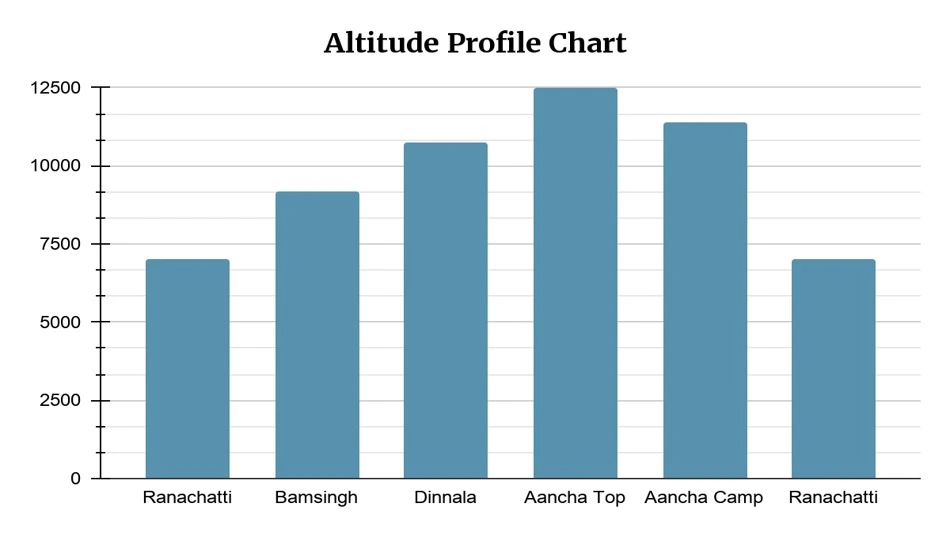
Here X-axis shows the following campsites listed below.
The Y-axis shows the altitudes.
- Rannachatti
- Bamsingh
- Dinnala
- Aancha Top
- Aancha Camp
- Ranachatti
Check
Route Map
Read
Inclusion
- Transportation: Dehradun to Gangotri on Day 1 and Gaurikund to Rishikesh/Dehradun on Day 14.
- Accommodation: Stay is included from Day 1 to Day 13. You will be staying at a guest house in Gangotri, Kedarnath, Gaurikund and in camping tents on other days.
- Meals: All meals from dinner at Gangotri on Day 1 to breakfast at Gaurikund on Day 14 are included. We provide simple, nutritious vegetarian food on all days of the trek.
- Camping charges: All trekking permits and forest camping charges are included.
- Trekking equipment: You will stay in high quality tents and sleeping bags in all the camps.
- Safety equipment: First aid and medical kit will be carried by our trek leaders and guides.
- Services of an expert Trek Leader: The trek leaders are qualified in mountaineering and first aid courses.
- Services of an expert Trek Team: The mountain staff on this trek consists of well-trained guides, cook and helpers.
Read
Exclusion
- Food during vehicle transit to Dehradun: The trek fee does not include meals purchased during the road journey to Sankri from Dehradun and back from Chitkul.
- Backpack offloading charges: If you wish to offload your backpack, there will be an additional charge of Rs 1,000 per bag per day (Day 2 to Day 13). The backpack cannot weigh more than 10 kg. Suitcases/trolleys/duffel bags will not be allowed. Please note that it may not be possible to offload the bag while already trekking on the route. It is advisable to inform in prior.
- Stay at Dehradun, Rishikesh.
- Personal expenses of any kind.
- Any medical emergency/evacuation/rescue will be assisted by our team but the additional charges for change in plans are to be borne by the trekker(s) concerned.
- Anything apart from inclusions.
Read
Other Information
Typical items included in the meals are:
- Breakfast: Wake-up Tea/Coffee, Biscuits, Aloo Paratha with Achaar, Boiled Egg, Bread with Butter/Jam, Fruit, etc.
- Lunch: Roti/Chapati, Rice/Chawal, Manchurian Rice, Salad, Dal (Rajma), Mixed-Veg, Kofta Curry, etc.
- Snacks: Tea, Coffee, Pakoda, Finger Chips, Veg Cutlet, Maggi, Soup, Popcorn, etc.
- Dinner: Roti/Chapati, Rice/Chawal, Matar Paneer, Mixed Dal, Salad, Papad, Sweets (Gulab Jamun, Jalebi), Fruit Custard, etc.
Weather and Climate Info:
Summer (May to June)
Accessibility: The route becomes accessible as the snow melts and the meadows are filled with greenery. Although on the higher parts of the trails it can be slippery, the Discovery Hike Trek Leaders can guide you easily.
Weather Conditions: Temperatures during both day and night are comfortable and stable, which makes it ideal for trekkers to opt for this season. Strong winds may blow at the upper parts of the trails, but it is normal for any alpine region.
Overview: Good time to trek to the Aancha Top as the routes are clear and can help people to take obstructed pictures of the surrounding mountains and wide meadows.
Monsoon (July to September)
Accessibility: The trails become slippery due to heavy rainfall, which makes it hard to find the routes. The mountain streams also become dangerous as their flow increases in speed and volume. The vegetation and forests are most dense during this period. Sudden heavy rainfall is quite common.
Weather Conditions: Rainfall is sudden and leads to landslides and active rockfall zones. The sky is mostly cloudy, and dense fog can also be experienced, making the route invisible.
Overview: The visibility is not good during this period, and it is doubled by the dangers of landslides. This is why it is not advised by experts to not opt for the monsoon season for trekking. Moreover, there is also a problem of leeches in the wet environment.
Autumn (September to November)
Accessibility: Accessibility is the highest during this season. The trail is dry and open up to the very top during this season. The ridge of the Aancha Top is also clear, which makes it reasonably easy compared to the other seasons.
Weather Conditions: The weather is highly predictable and quite similar. Rainfall in this season is non-existent, so there is no risk of skidding and less visibility. The day temperatures are pleasant, but the nights can be cold.
Overview: The meadows change from being green to golden yellow or brown, but the weather is clear, and temperatures are best suited for alpine adventure. This is the best time for people who love stargazing.
Winter (December to March)
Accessibility: The route is completely covered with snow but can only be completed by experienced trekkers, as technical skills and other equipment are needed.
Weather Conditions: The weather is cold with frequent snowfall throughout the season. The day temperatures are freezing, while the night temperatures are below the freezing point.
Overview: Generally not recommended for beginner trekkers but can be done if you are experienced and take proper guidance from the Discovery Hike Trek Leaders. The views during this trek are absolutely breathtaking as the entire region looks like a dreamland.
Temperature Overview
Summer (May to June)
Daytime temperatures: 14 to 20 ℃
Nighttime temperatures: 8 to 12 ℃
Post-monsoon/ Autumn (September to November)
Daytime temperatures: 8 to 15 ℃
Nighttime temperatures: 2 to -4 ℃
Winter (December to March)
Daytime temperatures: 2 to 8 ℃
Nighttime temperatures: -5 to -12 ℃
Mountain Ranges, River Valley & Lake
The region is filled with many mountain ranges, river valleys and lakes, which makes the experience of the trekkers even more fulfilling.
Mountain Ranges
The primary mountain ranges include the Garhwal mountain ranges, Bandarpoonch and Swargarohini ranges. Many peaks like Srikanta, Kedarnath and Jogin surround some part of the trek route. The Black Peak and the Gangotri ranges are also primary attractions along the route. The snow-capped peaks look mesmerising as you move along the route.
River Valleys
The Yamuna River Valley is the primary valley in the region, which provides water to the local people and animals. There are other mountain streams along the way, which add a special charm. Two of those streams are Daloti Gad and Jajar Gad, which join the Yamuna River downhill.
Lakes
Unlike many other treks, the Aancha Top trek does not offer a major Himalayan lake, but there are many streams which form small temporary ponds, especially during the melting season. It makes the trek route extremely photogenic and peaceful.
Geographical Highlights
Glacier
The route does not directly cross any glacier, but the Gangotri and Yamunotri Glaciers at a distance form a major attraction for trekkers and snow lovers. The Black Peak and Swargarohini ranges also have snow-capped peaks and glaciers, which offer a great view to anyone opting for this trek.
Meadows
The Dinnala Bugyal, sitting at an altitude of 10750 ft, is the primary meadow of the Aancha Top Trek. It offers lush greenery and an unobstructed view of all the major peaks. This makes it a great location for camping and also allows photographers to capture irreplaceable memories. The Gidara and the Dayara Bugyals can be seen in the distance, which looks as if those bugyals are gliding down near the hills.
High Altitude Passes
The summit of the Aancha Top is like a narrow ridge, which is the only high-altitude pass at an altitude of 12525 ft. Unlike high-altitude passes across valleys in most treks, the ridge walk allows the trekkers to have an adventurous experience.
Flora and Fauna
The Aancha Top Trek is home to some of the beautiful and unique flora and fauna, and these are discussed below.
Flora
In Lower Region
The lower regions are mostly filled with tall oak, pine and deodar trees, which offer dense shade to the trekkers and residents. Maple and rhododendrons are also quite common here, which add vibrant colours to the route, especially during the blooming season.
In Upper Region
The high altitude regions are filled with grasses, medicinal herbs and several colourful wildflowers, which make the scenery extremely beautiful. The Dinnala Bugyal is filled with nutritious alpine grasses, which are quite nutritious for the sheep and goats.
Fauna
Birds
There are many bird species, which include the Koklass Pheasant, Himalayan Monal and several high-altitude raptors. The photographers have a great opportunity to capture rare bird species that travel to the region occasionally.
Mammals
The Govind Wildlife Sanctuary is not far away from the region; therefore, Himalayan black bears and leopards are very common in this region, but they live in the deeper parts of the sanctuary and are rarely seen near the trekking route. Himalayan langurs can be seen frequently across the entire forest route. Barking deer are also common here but rarely come out in the vicinity of humans because of their shy nature.
Insects
Beautiful butterflies and alpine insects are common all across the trek where there are flowering shrubs and bushes.
Photography Tips
Golden Hours for Lighting:
Tip: Leverage the stunning lighting conditions during the golden hours – early morning and late afternoon. Capture soft and golden light that enhances the beauty of the landscape. Avoid midday when the light can be harsh, but it can also create compelling contrasts in the rugged terrain.
Flora and Fauna Focus:
Tip: Explore Aancha Top Trek’s rich biodiversity. Capture vibrant rhododendrons in spring, lush greenery in monsoon, and snow-covered trees in winter. Use a zoom lens for wildlife shots, maintaining a safe distance to avoid disturbing the animals.
Landscape Photography Essentials:
Tip: The panoramic views of the Himalayas are breathtaking. Keep a wide-angle lens handy to capture the vast landscape. Add depth and scale by incorporating elements like trekkers or tents in the foreground.
Experiment with Perspectives:
Tip: Vary your angles and perspectives for unique shots. A low-angle shot of a trail leading into the mountains can add depth and intrigue to your photos. Experimentation can lead to captivating compositions.
Rule of Thirds:
Tip: Compose balanced and interesting shots using the rule of thirds. Divide your frame into nine equal segments and place key elements along these lines or their intersections. This simple rule can significantly enhance the visual appeal of your photographs.
Capture Local Culture:
Tip: As Aancha Top Trek passes through quaint villages, document local architecture, people, and daily life. Seek permission before photographing individuals to respect their privacy and cultural norms.
Night Sky Photography:
Tip: Utilise the clear skies at high altitudes for astrophotography. Set up a tripod and use long exposure settings to capture the stars, and potentially the Milky Way. The serene nights in the Himalayas offer a canvas for stunning celestial shots.
Be Weather Prepared:
Tip: The Himalayan weather is unpredictable. Protect your camera equipment from rain and snow using weather-resistant gear. Keep batteries warm in cold weather to prevent quick drainage. Consider using lens hoods and covers for additional protection.
Travel Light:
Tip: Prioritise essential gear for high-altitude trekking. Minimise equipment to reduce the weight you carry. A lightweight and versatile camera setup will ensure you are agile and ready to capture spontaneous moments.
Respect the Environment:
Tip: Be mindful of your surroundings. Avoid damaging the natural environment or disturbing wildlife while capturing your shots. Leave no trace and follow the principles of responsible trekking and photography.
Bonus Tip – Patience is Key:
Tip: Sometimes, waiting for the right moment, light, or movement can make a significant difference in capturing a memorable photograph. Practice patience during your trek, and you might be rewarded with extraordinary shots that tell a unique story of your Aancha Top Trek adventure.
Things to Carry
Hiking Shoes
Type: We recommend that you have to look for shoes that are water-resistant and have a deep yet flexible sole to sustain on Himalayan terrains.
Note: Dynamic rough terrains hold uncertain threats. The pair of shoes that has the advantage of overcoming those threats will help you maintain your confidence in balancing.
Backpack
Type: It purely depends on the kind of Trek you are planning to do.
(15-20) litres will be ideal for short treks of (1-3) days.
(40-60) litres will be ideal for long treks of (3-10) days.
Note: A backpack is essential for activities like trekking. You will need your Backpack throughout the journey for your belongings and all the essentials you need. We recommend you test the bag and choose it according to your height, the Trek where you are taking it & and the comfort it provides.
Daypack
Type: A (10-15) litres waterproof daypack is all you need to have with you for the Summit.
Note: Your Daypack will be for those Summit days and shorter days when you just need your essentials (wallet, small water bottle, sunglasses, power bank, etc.) with you.
Clothing
Collared T-shirts – Carrying 2 – 3 units of collared T-shirts will be ideal. The collar will help you to keep your neck away from direct sunlight and not too exposed to the Sun and getting sunburnt.
Padded Jacket – Ensure that the jacket is wind-resistant & and capable of keeping you warm at -10 °C to -12 °C.
Fleece Jacket – Fleece jackets are made of very soft and cosy material. It helps you to maintain a comfortable body temperature. Keep 2 Fleece Jackets with you.
Thermals – You will have a requirement of only 1 pair of this in the Winter, For Summer it could be under consideration. It is made of pure cotton and designed in such a way that body heat is blocked between its layers. It will keep you warm during the nights when the temperature falls.
Trek Pants – You will have a requirement of 2 units of Trekking Pants with you always. Between them, one must be convertible. Ensure it is made of Cotton or a windproof, light material & and provides maximum durable comfort.
Sun Caps –The Sunlight might be harsh at higher altitudes, and direct exposure of sunlight to your head harms your skin. Carry Sun Caps to keep your head cool.
Woollen Caps – You will need woollen caps during the nights to keep your ears and head warm from the very cold breeze.
Waterproof Gloves – You will require waterproof gloves for cold and wet sections of the Trek. Always keep your hands clean and warm; avoid letting your hands get wet to maintain grip and balance.
Trek Accessories
Trekking Pole: The Trekking/Hiking Pole saves 60% of your energy for conquering a steep slope at a higher altitude. It is advisable to carry a trekking pole with you for the treks.
Head-lamp or Torch: A head-lamp is another important thing that also comes under mandatory items for our Treks. It will help you deal with the dark. Headlamps become more effective for walking in dark, cold weather without using your hands. The featured torch is also ok for uphill.
Daily essentials
Toiletries: We recommend you carry all your Toiletries essentials and all other personal belongings by yourself to avoid borrowing. Here are some items you could take: tooth-cleaning paste, toothbrush, lip moisturiser, skin hydrating cream, facial cleanser, a range of vital creams and items, bathroom tissue/toilet paper, menstrual pads, along with other important personal care items like shampoo, conditioner, deodorant, and shaving supplies.
Containers & Vessels: It’s advisable to bring your water containers; we recommend two bottles each with a capacity of 1 litre. Additionally, for both ease and hygiene reasons, please carry your food containers to use for the meals we supply. The metal bottle comes in handy for hot water served in the camps.
Recommended Medicines:
Gauze 1 small roll, Dexamethasone one strip, Nifedipine 5 tablets, Band-aid 10 strips, Avomine 4 tablets (motion sickness), Avil 25mg 4 tablets (allergies), Combiflam 4 tablets (Pain killer), Crepe bandage 3 to 5 meters, Disprin 6 tablets (headache), Crocin 6 tablets (fever), Digene 10 tablets (acidity), Omez/ Rantadine 10 tablets (antacids), Norflox TZ & Lomofen 6 tablets each (diarrhea), Diamox 10 tablets (to prevent AMS), Cotton 1 small roll
Essential Documents Required:
For the Aancha Top Trek, you must bring specific documents and submit them to the trek leader at the base camp. These include a copy of the Disclaimer, along with one photocopy and the original of a government-issued photo ID. Additionally, a doctor’s medical certificate confirming your fitness for high-altitude conditions is required.
Risks and Precautions
Here are the risks or challenges you might face on the Aancha Top Trek.
Risk of Slip/Skid:
Nature of Risk: The trail, particularly in winter (December and January), may be scattered with black ice, leading to a risk of slipping or skidding. Additionally, the unpredictable Himalayan weather adds to the challenge.
Safety Precautions:
- Briefing session at the base camp regarding slip/skid risks.
- You will get a trained trek leader’s guidance on maintaining balance and proper use of trekking poles.
- Provision of crampons by Discovery Hike for snow-filled trails to reduce the risk of skidding by up to 95%.
- Continuous awareness communication from the trek leader during the trek.
- Choosing trekking shoes with a good grip is crucial.
High Altitude Risks:
Nature of Risk: Ascending from 6,400 feet to 11,500 feet over 4-5 days may lead to Acute Mountain Sickness (AMS), High Altitude Pulmonary Oedema (HAPE), and High-Altitude Cerebral Oedema (HACE), especially at higher camps.
Safety Precautions:
- Start DIAMOX from the first day to reduce AMS risk.
- Trained leaders recognise AMS symptoms and are equipped with a high-altitude medical kit.
- Oxygen cylinders are available for safety.
- Immediate descent if conditions worsen.
Dealing with Blisters and Cramps:
Nature of Risk: Blisters, cuts, and cramps can occur on uneven trails.
Safety Precautions:
- Trekkers should inform the trek leader promptly.
- Well-fitting, breathable trekking shoes are recommended.
- A treatment kit with the trek leader and application of cramp spray for leg cramps.
Weather Risks at High Altitude:
Nature of Risk: Unpredictable weather, particularly in the Himalayas, can worsen quickly.
Safety Precautions:
- Trek leader’s decision on continuing or waiting for better weather.
- Provision of all-weather tents to cope with different weather challenges.
Communication Risks:
Nature of Risk: Communication signals weaken and may be lost completely at higher altitudes.
Safety Precautions:
- Use of walkie-talkies for alternative communication between different campsites.
Emergency/Immediate Rescue:
Nature of Risk: Severe health issues or emergencies may necessitate immediate rescue.
Safety Precautions:
- Quick utilisation of resources like porters and mules for rescue. *Rescue cost is not included in the package.
- Standby team at different campsites for assistance.
- Airlifts are arranged in acute cases. *The cost of airlift is not included in the package.
Risk of Low Oxygen at Higher Altitudes:
Nature of Risk: Oxygen levels decrease with altitude, potentially causing breathing difficulties.
Safety Precautions:
- Availability of oxygen cylinders with the trek leader and staff.
- Affected trekkers should inform the leader or descend to a lower campsite for immediate help.
- Overall Safety and Cooperation:
- Cooperation is essential for safety and enjoyment during the trek. Discourage the use of objectionable substances during the trek for overall safety and well-being.
Cancellation Policy
Initiating Cancellation:
To cancel your booking, please send an email to: [email protected]
Cancellation Due to Unforeseen Events:
In case of trek cancellation by Discovery Hike owing to unexpected events such as natural disasters, floods, or political unrest, we will issue a trek voucher. This voucher is valid for one year and can be used for the same or a different trek.
Cancellation Due to Personal Reasons:
If you decide to cancel your trek for personal reasons, the following terms apply under our cancellation policy:
No Cash Refunds: We do not offer cash refunds once a booking is completed. Instead, a voucher for the same or a reduced amount will be provided.
Cancellation 30 Days or More Before Trek: If you cancel 30 days or more before the trek start date, a voucher for the full booking amount will be issued.
Cancellation 20-29 Days Before Trek: For cancellations made between 20 and 29 days before the trek start date, 50% of the booking amount will be deducted. The remaining amount will be provided as a voucher.
Cancellation Less Than 20 Days Before Trek: No voucher will be issued for cancellations made less than 20 days before the trek start date.
Seasonal and Occasional Activities
The Aancha Top Trek gives the trekkers an amazing opportunity to explore everything that the Himalayas have to offer, from dense alpine forests to narrow ridge walks and from beautiful mountain streams to breathtaking views of the snow-capped peaks. All trekkers can engage in many activities that the Aancha Top Trek has to offer. Some of them have been discussed below.
Seasonal Highlights
Spring (March to May)
This is an ideal time to visit the trek as the snow starts melting and the rhododendrons and other wildflowers start blooming. The skies are clear, and the views are beautiful. The valleys look serene, and the route is also clear.
The weather is extremely pleasant and far from being harsh, which makes the entire trekking experience satisfying for the people opting for the Aancha Top Trek.
Summer (June to August)
The trails are at their peak as the snow has melted away completely. The meadows and valleys start becoming green, and flowers are at their peak during this period. The views of the surrounding peaks become clear, which fills the trekkers with enthusiasm.
Follow the guidance of the trek leaders of Discovery Hike, as the Black bears and leopards might come out in the nearby areas during this season. The temperature is on the higher side during this season, and nights are not as cold as in other seasons. Just like the spring season, the summer is also a good time to go for the Aancha Top Trek.
Autumn (September to November)
The skies are at their clearest, along with green meadows and valleys. This is by far the best time for trekking in general. The scenery is crisp, and the weather is cool and pleasant.
The weather is quite stable during this period. The days have normal temperatures, but the nights tend to be on the colder side. It is good for people who want to enjoy alpine temperatures but not harsh weather conditions.
Monsoon (June to September)
The rainfall is heavy and sudden, with strong winds blowing throughout the day. The routes become extremely slippery, and there is a constant risk of skidding, landslides and rockfall. The meadows and valleys are at their peak greenery during this period, and the smell of the wet soil is also amazing.
It is recommended not to choose monsoon as the trekking season, as every year many people meet with accidents and lose their lives in this region due to landslides and floods.
Winter (December to February)
During the winter, the route to the Aancha Top is fully covered with snow, and sudden snowfall is very common. The daytime temperatures are freezing, while the night temperatures fall below the freezing point. Strong snowstorms occur frequently during this period.
Although the region looks like a wonderland during the winter, the trek is generally not recommended during this period due to many obvious and some hidden dangers along the route. Experienced Trekkers can do this trek with the guidance of the Discovery Hike Trek Leaders.
Occasional Activities
Phool Dei
The locals welcome the spring with the Phool Dei festival, where they collect wildflowers and spread petals all across the village as a symbol of prosperity. Folk songs and dance are also performed by the locals to celebrate the event. The trekkers can join the locals during the Phool Dei festival and get absorbed into the local culture for some time.
Olgia
The Oligia festival is celebrated to show gratitude towards the harvest in agriculture. The festival signifies abundance of farm yield and also wealth. The locals prepare clarified butter, or ghee and apply it on their forehead. They also enjoy home-cooked flatbreads with stuffing inside as a symbol of gratitude and abundance.
Magh Mela
The locals make palanquins with intricate designs for the idols of the deities as a symbol that the deities have come down to them for showering blessings. This festival is celebrated to show gratitude towards the deities who are believed to be protecting the locals from natural disasters and other unforeseen dangers. The trekkers can participate in the folk dances with the locals, which can help them build even more memories.
Bissu Mela
Bissu Mela is very popular among the locals and among the trekkers who opt for the spring season for the trek. Folk dance forms like Jhora and Thadya pay tribute to the renewal of the beautiful weather after the harsh winter months. The celebration is extremely energetic, which can fill the trekkers with enthusiasm before starting the trek.
Bird Watching and Star Gazing
The flora and fauna are unique and beautiful, so the bird watching is worthwhile on the Aancha Top Trek. Spring and autumn are the best seasons for birdwatching as many rare birds travel to lay eggs to avoid the harsh winter and monsoon months. The sky is also clear during these seasons, which can allow the trekkers to lie down in the meadows and engage in stargazing.
Local Language Phrases
Hello – “नमस्कार” (Namaskar)
How are you? – “तुम कसै छौ?” (Tum kase chau?)
My name is – “मेरु नाम …” (Meru naam …)
I am fine. How are you? – “मी ठीक छौं. तुम कसै छौ?” (Mi theek chaun. Tum kase chau?)
Please help me. – “कृपया, मेरी मदद करें.” (kripya, Meri madad karen.)
Tell me the route. – “मुझे रास्ता बता.” (Mujhe rasta bata.)
Where am I right now? – “मी अभी कख छौं?” (Mi abhi kakh chaun?)
Please rescue me. – “कृपया मुझे बचाओ.” (Kripya mujhe bachao.)
Do you have medical kits? – “क्या तुमरे पास मेडिकल किट छै?” (Kya tumre paas medical kit chhai?)
Will you join me? – “तुम मेरु साथ द्याओलु?” (Tum meru sath dyaolu?)
How long will it take to reach the summit? – “शिखर तक पहुंचण मा कती समय लगोलु?” (Shikhar tak pahunchan ma kati samay lagolu?)
Where is the next Maggi point? – “अगला मैगी प्वाइंट कख छ?” (Agla Maggi point kakh ch?)
Will there be too much cold? – “क्या ज्यादा ठंड ह्वालि?” (Kya jyada thand hwaali?)
What is the name of the nearest village? – “नजीकी गांव का नाम क्या छ?” (Naziki gaon ka naam kya ch?)
Is there any update of heavy snowfall? – “क्या भारी हिमपात कु अपडेट छ?” (Kya bhari himpaat ku update ch?)
Check
Upcoming Batches
May :
1st – 31st May
Check
Our Gallery
Read
FAQ's
The pickup for the Aancha Top Trek is scheduled in Dehradun. The vehicle will wait for a maximum of half an hour in case of delays or genuine issues raised by the trekkers.
The best time to undertake the Aancha Top Trek is from March to June and September to November. These months offer pleasant weather and captivating landscapes.
In summer, temperatures on the Aancha Top Trek can range from 8°C to 20°C, while in winter, it may drop to 5°C to -12°C.
The trek concludes in Ranachatti for the Ranachatti-Ranachatti Package, and we will arrange transport from Ranachatti. Generally, we keep the drop-off vehicle Ready in advance for the Dehradun to Dehradun Package. The expected arrival in Dehradun is by 18:30.
Tents are usually shared by three trekkers. If you prefer a two-person tent, you can opt for it at an extra fee. Payment for customisation needs to be made instantly through Cash/bank transfer.
Discovery Hike will arrange tents and sleeping bags designed for harsh conditions.
An experienced trek leader and qualified staff from Discovery Hike will ensure a safe and comfortable journey.
Normal shoes with good grip and water resistance are sufficient. Crampons and gaiters are provided for specific trail conditions.
Yes, the Aancha Top Trek can be attempted by beginners and experienced trekkers, as the trek is categorised as an easy to moderate trek.
Ponchos will keep you dry while trekking, and waterproof tents are provided. It’s advised to buy a rain cover for your bag.
Yes, trekking poles are essential, reducing energy expenditure by 60%, especially during high-altitude treks.
Similar treks include Kedarkanta and Brahmatal Trek, suitable for beginners and experienced trekkers. It offers breathtaking views as well.
Yes, it’s suitable for children aged 8 and above, provided they are fit and can hike around 5 km daily.
Generally, there are 3-4 toilet tents in every camp with gender-specific dry pits.
Yes, it’s available. Trolleys/suitcases are not accepted for offloading.
You can fill your bottle from natural sources like cascades, consulting your trek leader before filling it.
Carry 2 litres daily to stay hydrated.
Good Jio and BSNL networks are available till Ranachatti. Charge devices here, as there are no charging points afterwards.
Wear layers, including thermals, sweaters, and jackets. Socks and a woollen cap are essential.
Yes, there’s a luggage room for storage at Ranachatti Base Camp during the trek.
Basic trekking gear, a declaration, and a medical certificate.
Yes, items like ponchos, poles, jackets, shoes, etc. are available for rent.
A balanced diet varies with altitude, including breakfast items like eggs and parathas, and meals with daal, rice, vegetables, and chapattis. Meal variety is changeable and subject to availability.
Local hotels and dhabas have toilet facilities. You can opt to freshen up there.
The Aancha Top Trek ends in the Barua village in the Kinnaur District.
The Aancha Top Trek is around 22-24 KM and takes around 6 days to complete.
The altitude of the Aancha Top Trek is around 12525 ft at the highest point, which is the Aancha Top.
₹ 15,000
₹ 11,000 INR 28% off
Per Person
Key Highlights
- ➧ Duration : 6D/5N
- ➧ Elevation : 12525 ft
- ➧ Best Time : May, June ,Sept, Oct
- ➧ Pick Up & Drop : Dehradun
Upcoming Batches
For Any Queries
+91-9458118063 | +91-7579480944
Read
Client's Feedback
Verified Phullera Ridge Trek. It was a great experience to trek over phullera ridge with discovery hike. The ridge trek was very very challenging as well as full of excitement. Enjoy those days with nice guide, foods and other facilities that provided by the discovery hike.Posted onVerified Outstanding Behaviour of Ganga, Prakash & the team were very heart warming.. They provide us outstanding foods and accommodation.Posted onVerified Bali Pass ( Discovery Hikes ) If you like to get drenched in nature then this is it ! Bali Pass is full of unexplored jungles, flower valleys, waterfalls, glaciers and wild berries to eat 🤤 All this experience gets even more amazing when you have an experienced crew by your side ! Discovery hikes provide you with an unforgettable experience coz they provide you with great food (tasty) & sweet dish at an altitude you cant expect. Moreover, the survival tips and they take care of your tantrums like a mother 😅 Ganga Rana, Mayank bhaiji & team made our experience more comfortable and we did the summit with moderate ease. Safety wise, it's a heads up with this team. P.S. - If you that guy who lags behind everytime and gets exhausted very easily 😂, Don't worry ! Discovery hikes won't leave you alone ! There is a guide each in the front, middle & back of the group.Posted onVerified Super duper adventurous trip ever Myself Kirti from Delhi...this is my 2nd trek with discovery hike team..Bali pass is a high altitude and long trek which needs everything like medication food shelter washrooms and mental support and motivation....and I must tell Ganga & Govind Rana team provides us everything whatever say variety of food like jalebi, gulab jamun, shahi toast, soup, noodles, pakoda, rajma rice,,there is no ending of food varieties for all days which we never expect from anyone in 16200ft,,,both guys and his team like porters all are very very supportive in all stages,,always they ready to giving his hands to someone's hands for support (jinka ❤️ sensitive h like me),,,,, they never say NO,,,,, I was in need of extra support for trekking and these guys gave me full support from starting to end.....in every step I scared from walking but Govind & Ganga were saying to me "DARNA NAHi JAb MEI HU...kahe darna..mei kheti ok sir😝😝😝....their tents/sleeping bags was good....there was lots of activities between the way like rappling, river crossing,, hiking,, ect....if u like adventure then u should go with this team.... discovery hike team is very hardworking by nature....thankss to alllll Ganga & Govind discovery hike team for Marvelous Adventure I had ever in my life.............we will come back again......seeeuuuuuSooonnn.....Posted onVerified Best treking company in Himalayas One of the finest treking company in Himalayas of India. They serve you the best food more the 4 times a days. Sweets in dinner and very friendly people always ready to solve the problem we face on the trek. Very humble and professional people. Love to trek with ganga and his team. Thank you for the wonderful 👏 experience.Posted onVerified Discovery hike Amazing experience with discovery hike spacial thanks to mr. Ganga rana for providing such a great service with exoerienced guide....i did 3 treks with the company.. Harkidun kedarkantha and balipass... I had a good time on the trail... Five star.. 🖤Posted onVerified Bali pass trek I trek with Discovery Hike on Bali Pass from 3-11 September 2021. I had experienced many treks with different adventure companies but Ganga bhaiya and his team is one of the best in all fronts, he and his very best team take care of us. One of the things that needs to complete a difficult trek is food they provide you excellent food, at such a high altitude their food quality doesn't depreciate. Thanks to Ganga bhaiya, Mayank bhaiya and Govind bhaiya and all the staff of Discovery Hike we made it till end. The very last day is like leaving a family. All the best for future expeditions.Posted onVerified Most recommendable Team....worth time and Money This was the best trip we ever had... although with Ganga as guide trip becomes more and more interesting every time , his motivational and thrilling Stories keep us goin on and on plus food is sth beyond compare as it is very difficult to have good food on very high altitude but they made it..his team is the best, very supportive and friendly. They helped us every time we were exhausted and kept us safe till the last destination which was recommendable job. Looking forward to next trip 🤟🏻🥳Posted onVerified Trek with Discovery Hike is like full paisa vasool. This is my 3rd trek with discovery Hike. Trek with discovery Hike is awesome and memorable. I started my trekking journey from Delhi with my friends and they pick us from Dehradun to Sankri Village by comfortable taxi and provide us very delicious and tasty food. Provide A very helpful, experienced guide. At the high altitude, they provide us very warm nd hygiene tents and sleeping bags. and no one can match their taste in food. Thank uh so much Ganga Rana, Govind bro and all team of Discovery hike for providing us all facilities, delicious food, good memories and lot of fine experience. I'll do more treks with ur team.Posted onVerified Best winter trek with the best people Had an amazing experience with Discovery Hikes. Thanks to Randev Ji Urf Hodda Ji for being an amazing trek guide. 😊Posted on
Checkout
Other Trek