Overview
Black Peak Base camp – Har ki Dun trek
Black Peak, at 6,387 meters/20960 feet, is the highest peak in the SaraswaE mountain range near Ruinsara Valley in UQarakhand’s Garhwal Himalayas. Since the top part of the peak resembles a Black Cobra, Black Peak is known as “Kalanag” in the local dialect. It is the highest and most prominent peak in the Bandarpunch massif. This peak was first summited by Jack Gibson and the students of Doon school in 1955. Swargarohini (6,252 m), though slightly lower, is way tougher to climb than Black peak. Very few successful climbs have been done.
The meadow named KyarkoE is the combined basecamp of Swargarohini and Black Peak. It lies right at the Southern base of Swargarohini. Black Peak is further up in the valley. Only a part of Swargarohini is visible from here, though it is closer. The top of Black Peak can be seen on the other hand.
Har ki Dun, on the other hand, lies on the Northern base of Swargarohini peak. This face of the peak is yet to be climbed, possibly owing to its steeper relief.
Read Our
Detailed Itenerary
Day 01: Dehradun to Sankri – 8 h drive
We start the journey early from Dehradun and drive iniEally to the famous hill staEon of Mussoorie. We follow the river Yamuna upstream. Purola is the last big seQlement on the route with a large market. So, it is recommended that the trekkers can buy anything they might have missed out by Purola itself.
The drive acer Purola is through a beauEful forest of pine trees. From near the village of Mori, the river Tons flows beside us Ell about Netwar. The fall in temperature can be felt from here. We officially enter Govind Pashu Vihar Wildlife Sanctuary acer we cross a check post at Netwar. It can be considered the southern
gateway to the sanctuary as most of the treks across the region are accessed from here onwards. The northern border of the sanctuary merges into Himachal Pradesh. Close to here, the rivers of Rupin and Supin merge to form Tons, which is the largest tributary of Yamuna and in fact larger than Yamuna itself, in terms of volume of flow. The peak of Kedarkantha can be seen from various points along the way from here.
We reach Sankri by early evening or late acernoon. It is a small village with a central market lined with a few shops. The village has numerous apple orchards which are harvested starEng from monsoon. The market area is new compared to the old village area, a part of which is known as ‘Saud’. The village also produces peaches, apricots, potatoes and other vegetables. One can see the Swargarohini peak from here on a clear day. We rest at night in a guest house.
Day 02: Sankri to Seema (2,600 m) – 1 h drive + 2-3 h trek (~4 km)
Acer breakfast we board an SUV and drive through forests and villages for about an hour. This is a new road. The trek commences from the village of Dhatmir or Dharkot on a stony path. We walk downhill for a short distance Ell we reach the river. The village of Gangad is visible not the opposite site of the river. From here, the path crosses over a few streams which merge with Supin. We reach the small seQlement of Seema and camp here.
Day 03: Seema to Ruinsara lake (3,600 m) – 15 km
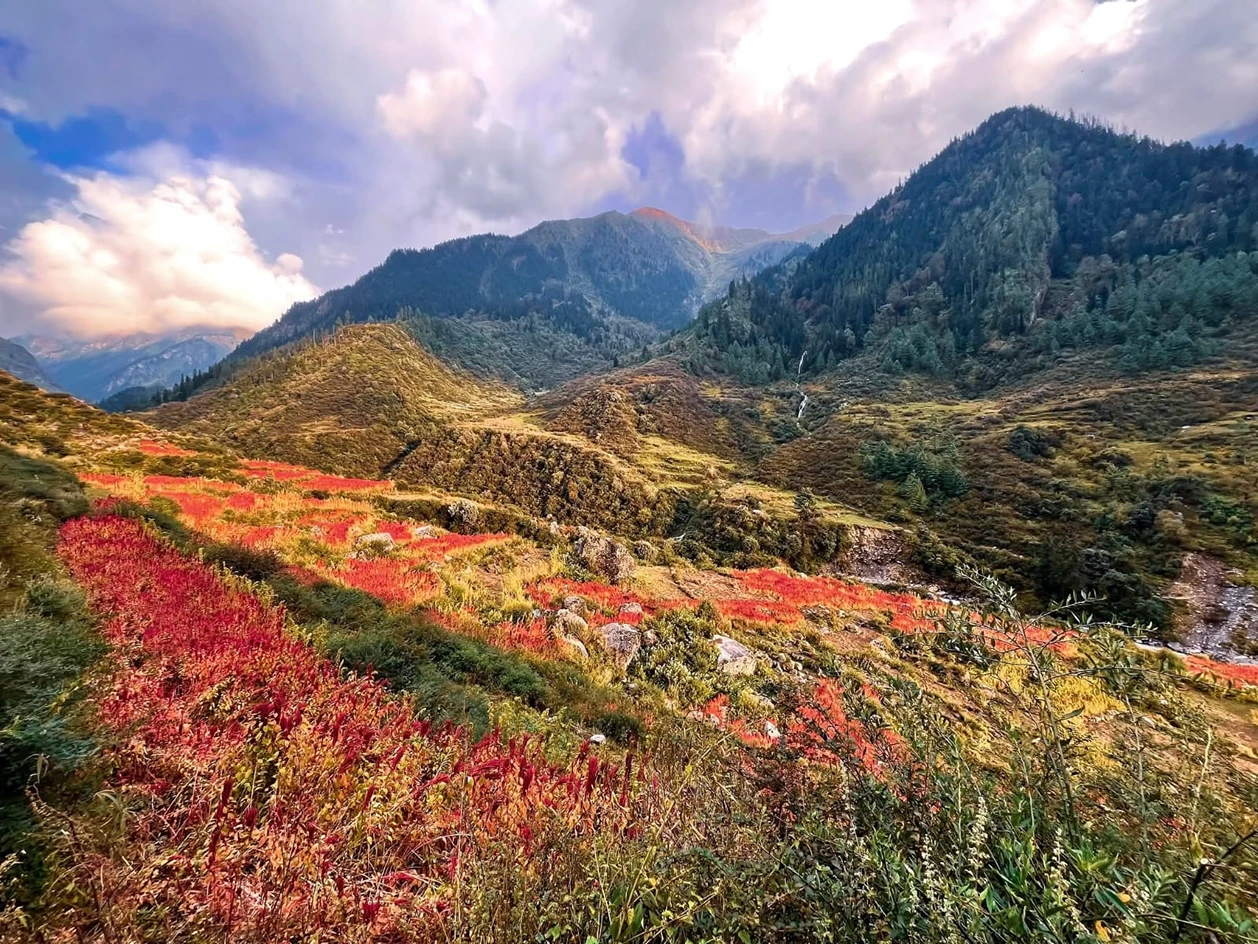
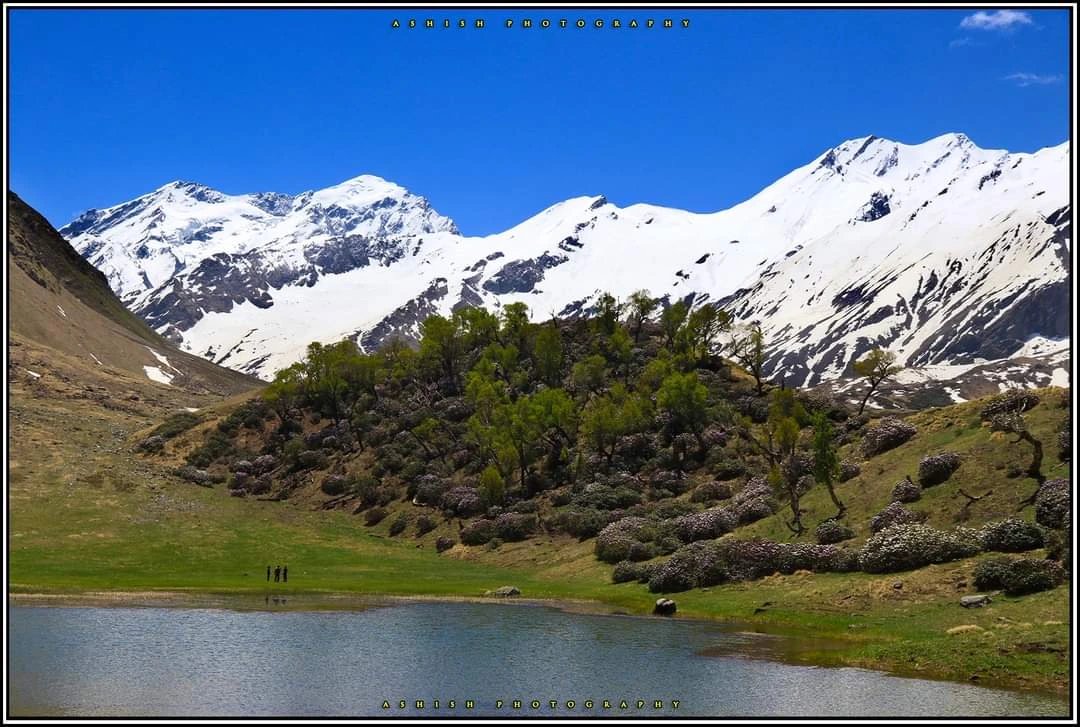
To get to the holy Ruinsara Lake, we walk along a spectacular alpine trail. From the meadows of Debsu, the views of the Swargarohini Range are especially stunning. Acer a short descend and further upstream along the river, we get our first glimpse of Black peak. A forest of Himalayan Birch trees greets us on the way. The final stretch ascends away from the main river and we reach our campsite beside a wooden hut. The lake lies a few meters ahead of us. From here we can see the route towards Bali Pass on the opposite side of the valley.
Day 04: Ruinsara lake – KyarkoF (Base Camp) (4,200 m) – 7 km
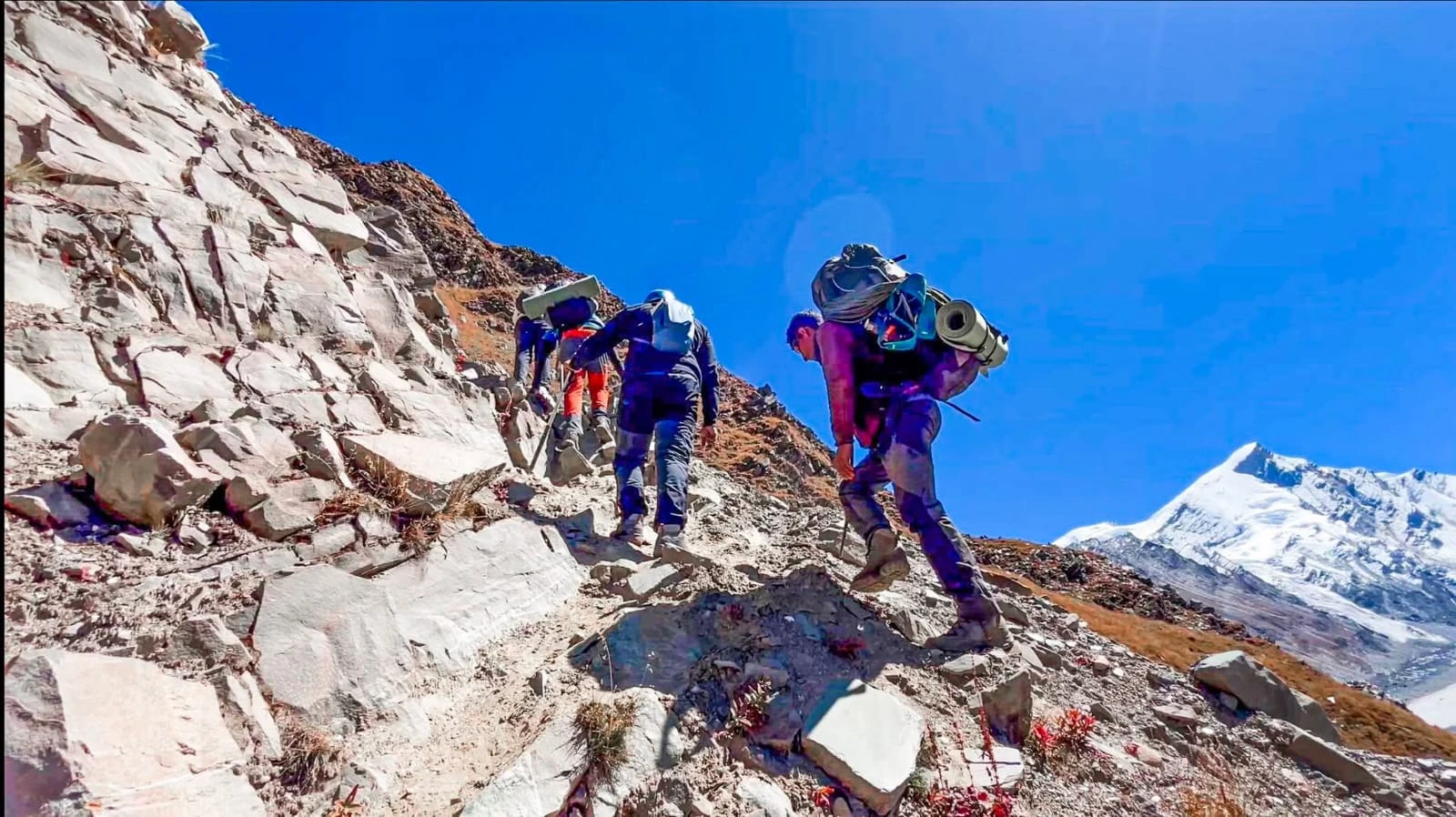
The trail starts over meadows conEnuing from Ruinsara lake. There are a few streams on the way. Slowly, the landscape becomes patched with boulders. We also traverse a rocky ledge. The last part is over waves of rolling meadows strewn with boulders.
Day 05: KyarkoF (Black peak basecamp) rest day
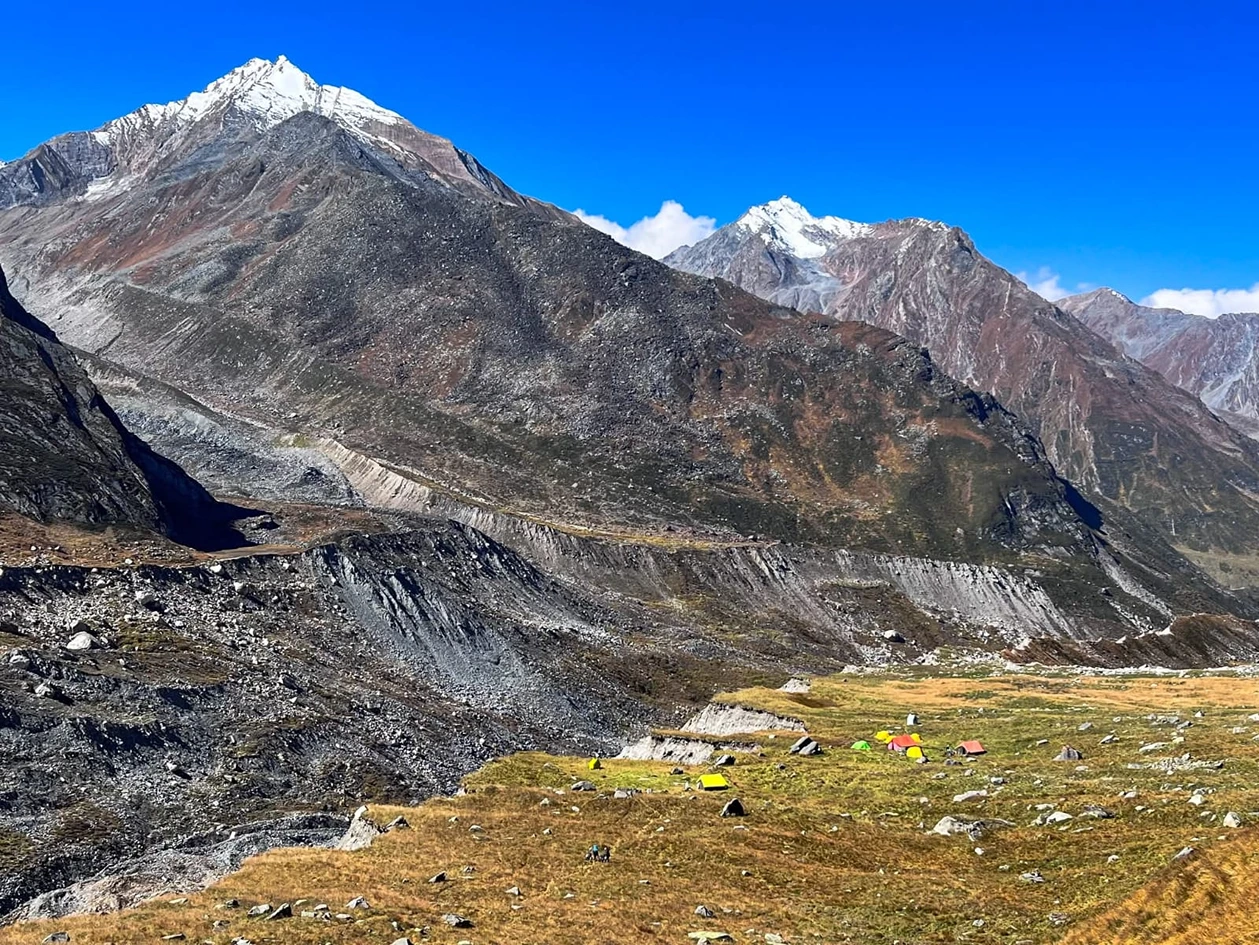
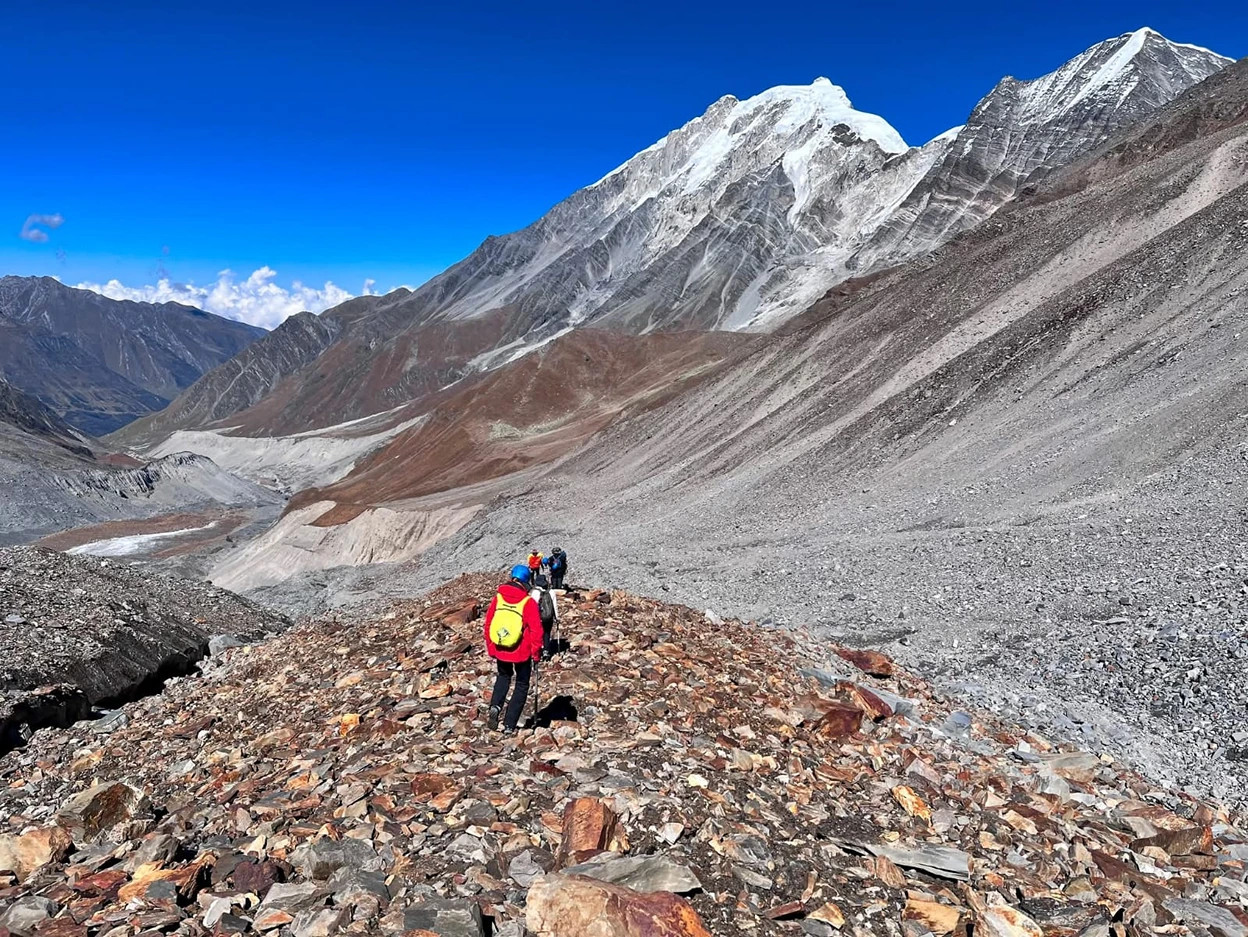
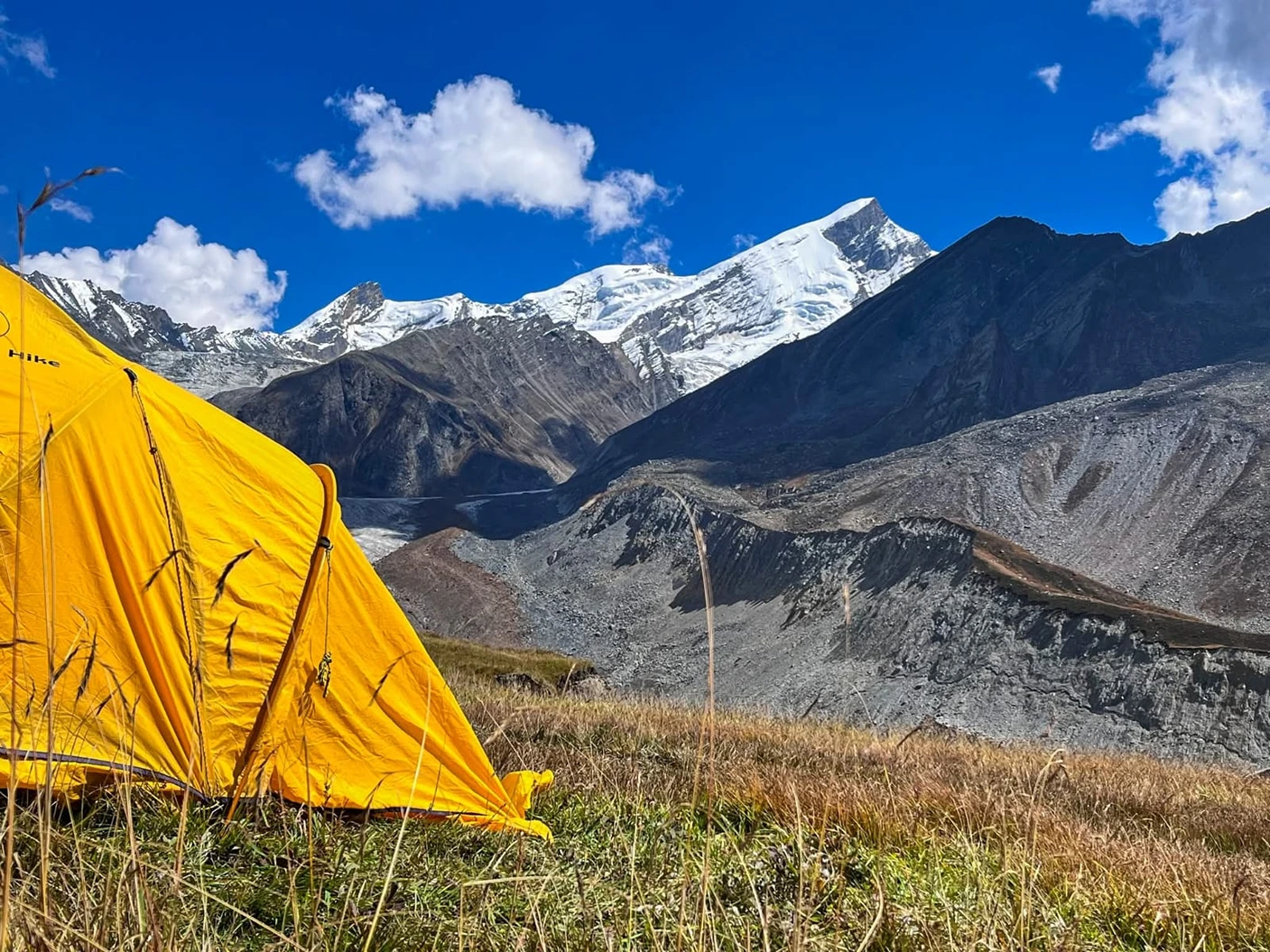
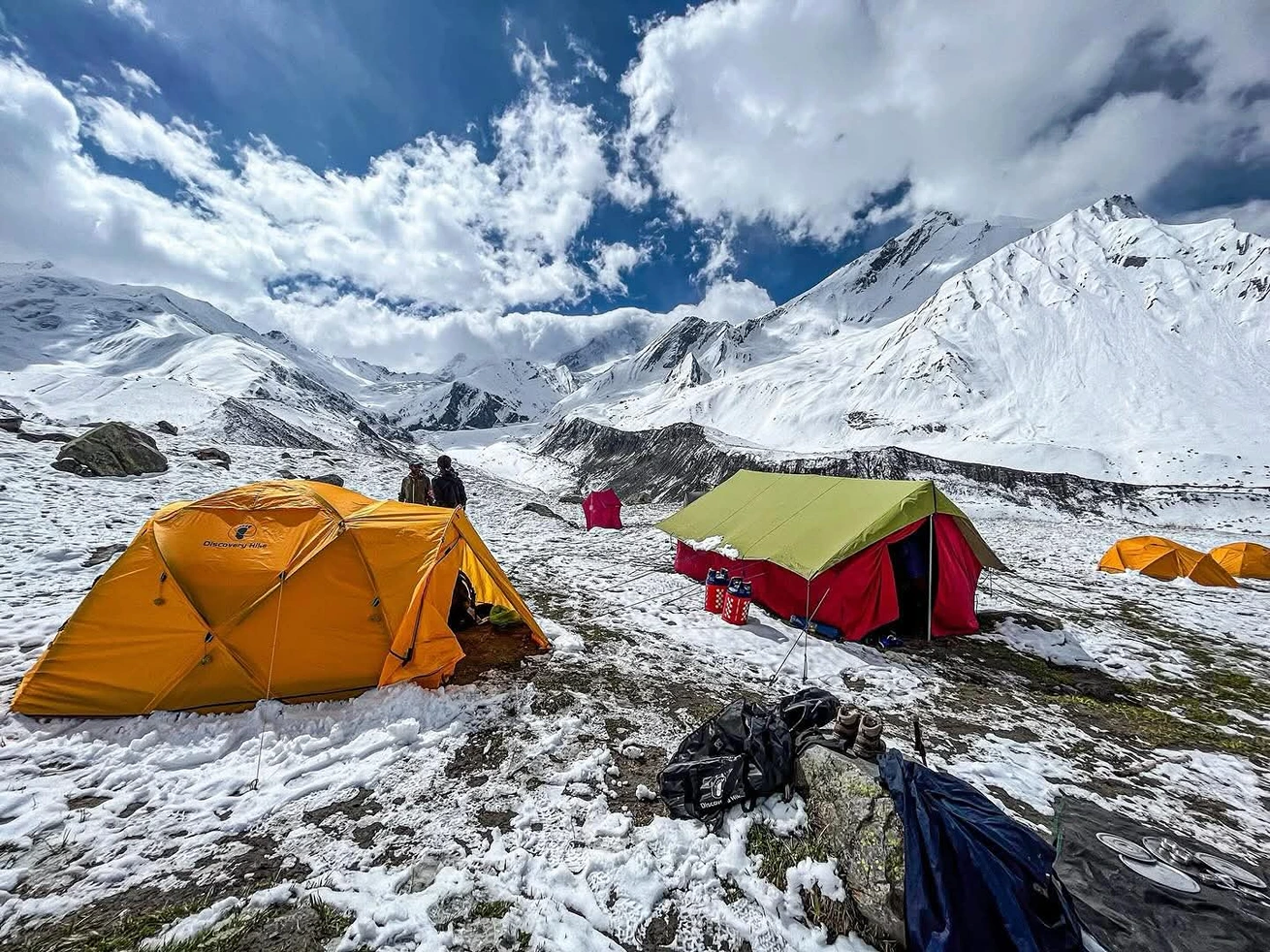
KyarkoE is a grassy patch of land on a shelf, located right at the boQom of Swargarohini peak. Below the shelf, a glacier feeds into the river we saw at Ruinsara. On all sides, it is surrounded by snow-capped mountains. From the base camp, you can see Black Peak clearly. We soak in the nature and beauty surrounding us. We can also have a day hike further and come back.
Day 06: KyarkoF to Waterfall camp (3,000 m) – 15 km
We walk back via the familiar route to cross Ruinsara lake and camp further down near a waterfall.
Day 07: Waterfall camp to Har ki Dun (3,400 m); Camp at Boslo (3,200 m) – 15 km
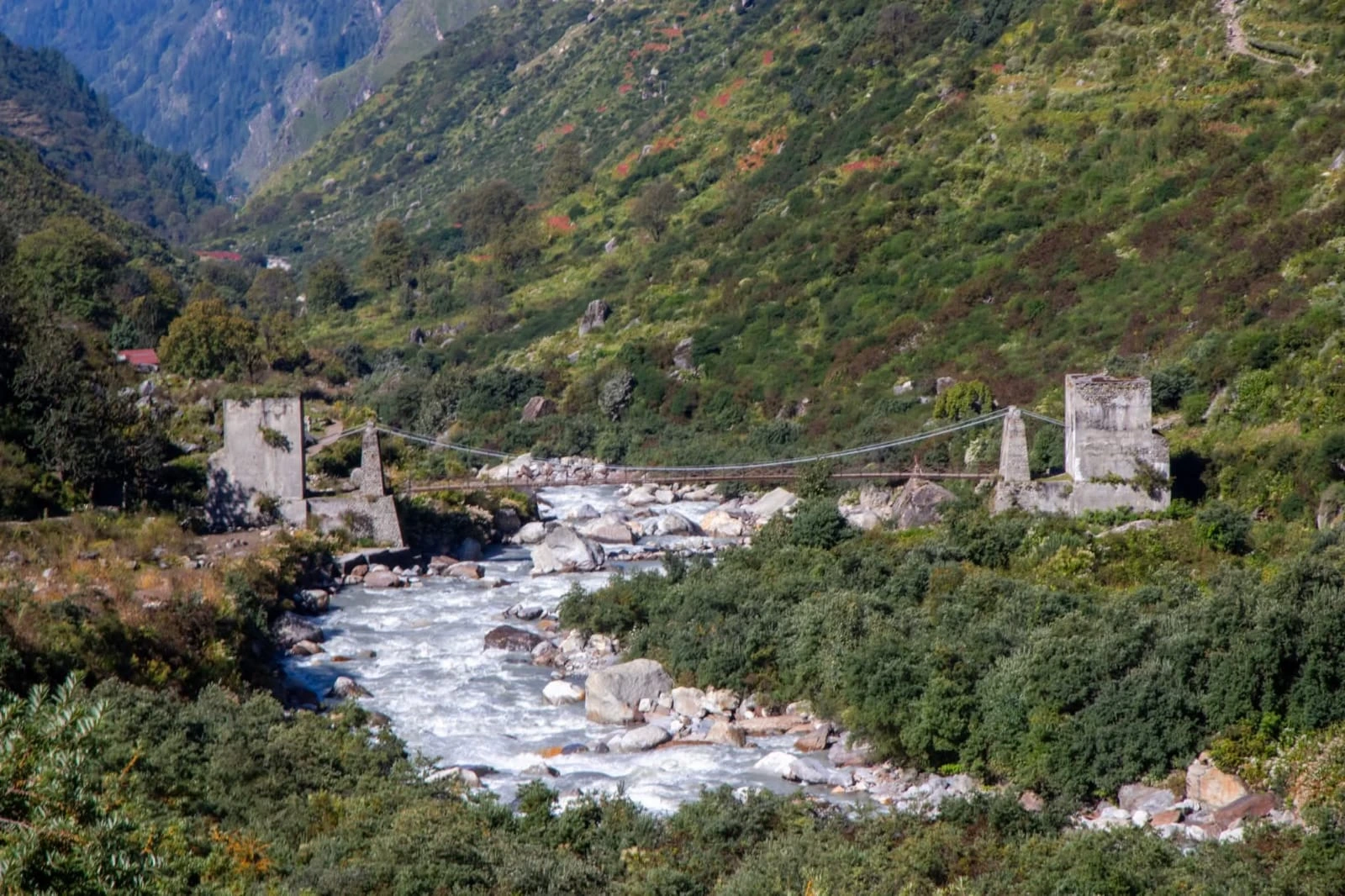
From our campsite we walk along the river downstream. Skipping the diversion towards the bridge on our lec, we take a trail into a dense forest. Further ahead we cross a bridge to reach our campsite Boslo. From here, Har ki Dun is a short distance. We trek back to our camp.
Day 08: Waterfall camp to Har ki Dun (3,400 m); Camp at Boslo (3,200 m) – 15 km
An easy walk on the popular trail from Har ki Dun leads us to the village of Osla. We can roam in the village. Our stay will be in a homestay.
Day 09: Osla to Sankri to Dehradun – 4 km trek + 9 h drive
From Osla, a downhill trail leads us back to the first day’s route. The trek should take around an hour. A vehicle takes us to Sankri. From Sankri, we shic to another car which drives us all the way to Dehradun.
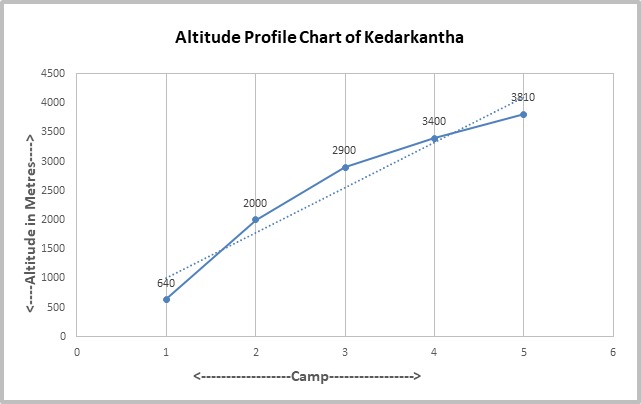
Here X-axis shows the following campsites listed below.
- Dehradun
- Sankri Base
- Shephard camp (Juda ka taal)
- Base Camp
- Summit
The Y-axis shows the altitudes.
Check
Route Map
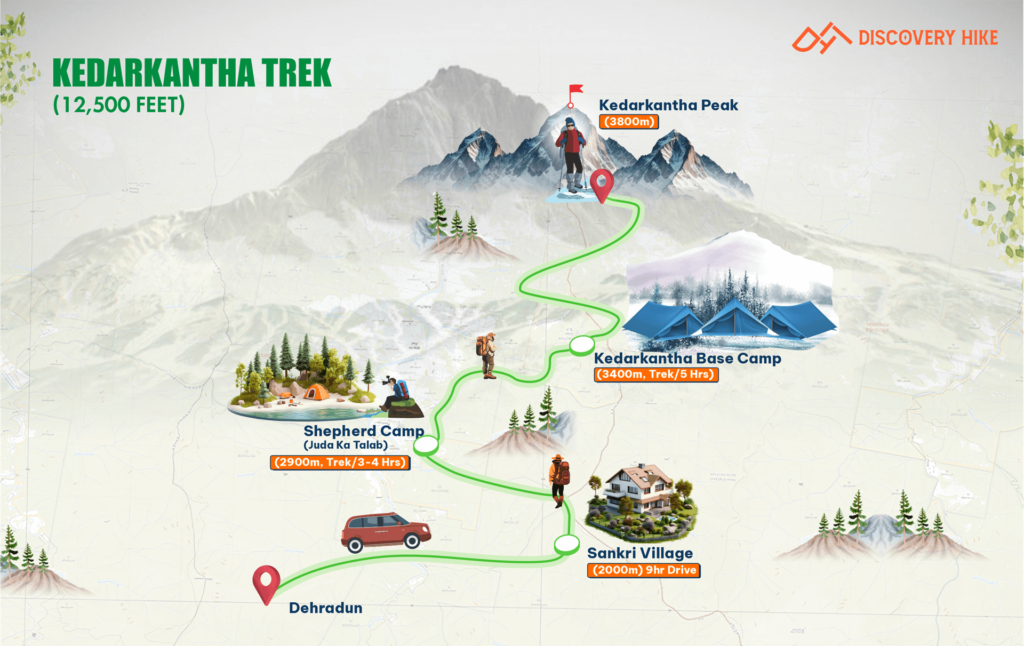
Read
Inclusion
- Transportation: Dehradun to Dharkot/Dhatmir and back.
- Accommodation: Stay is included from Day 1 to Day 8. You will be staying at a guest house or permanent camp in Sankri, in a homestay in Osla and in camping tents on other days.
- Meals: All meals from dinner at Sankri on Day 1 to breakfast at Osla on Day 9 are included. We provide simple, nutritious vegetarian food on all days of the trek.
- Camping charges: All trekking permits and forest camping charges are included.
- Trekking equipment: You will stay in high quality tents and sleeping bags in all the camps.
- Safety equipment: First aid and medical kit will be carried by our trek leaders and guides.
- Services of an expert Trek Leader: The trek leaders are qualified in mountaineering and first aid courses.
- Services of an expert Trek Team: The mountain staff on this trek consists of well-trained guides, cooks and helpers.
Read
Exclusion
- Food during vehicle transit to and from Dehradun: The trek fee does not include meals purchased during the road journeys on Day 1, 2 and 9.
- Backpack offloading charges: If you wish to offload your backpack, there will be an additional charge of Rs 3,000 per bag in total (Day 2 to Day 9). The backpack cannot weigh more than 10 kg. Suitcases/ trolleys/duffel bags will not be allowed. Please note that it may not be possible to offload the bag while already trekking on the route. It is advisable to inform in prior.
- Stay & Unplanned Transport: Stay at Dehradun.
- Personal Expenses: Personal expenses of any kind.
- Rescue Cost: Any medical emergency will be assisted by our team but the additional charges for change in plans are to be borne by the trekker(s) concerned.
- Others: Anything apart from inclusions.
Read
Highlights
Things to Carry:
Trekking boots: We will cover a long distance on each trek day. So, proper trekking boots which are comfortable, tough, have good ankle support and excellent grip are needed. Also, they must be water resistant.
Backpack (with sturdy straps and supporEng frame) and rain cover.
Clothing:
- Two trek pants: Carry at least one spare trouser in case the first pant gets wet. The pants should be loose and flexible. Avoid denims and shorts.
- Windproof jacket, down/feather jacket and fleece/woollen sweater.
- Three shirts/t-shirts: preferably full-sleeved and quick dry.
- Thermals for night (the fleece/woollen layer can also be used)
- Raincoat and rain pants (poncho is an alternaEve)
Accessories:
- Sunglasses
- Sun cap
- Hand gloves: One pair of waterproof and one pair of woollen/fleece gloves.
- Balaclava or woollen scarf (to keep the neck, ears and head warm).
- Socks: 3 pairs of sports socks; 1 pair of woollen socks for the night.
- Headlamp
- Daypack (20-30 litres): A smaller backpack will be needed by those offloading the rucksack to carry water, medical kit and some light snacks. It will also be kept with us during the drive since the larger bag will be loaded on top of the vehicle.
- Toiletries: Sunscreen, moisturizer, light towel, lip balm, toilet paper, toothbrush, toothpaste, hand saniEzer.
- Carry a waterproof pouch for wet clothes.
- Two water boQles
- Trekking pole (opEonal): It provides addiEonal support.
- Tiffin box (for packed lunch)
Personal Medical Kit (include a basic knee and ankle support
Mammals
Langur, Wild Fox, Indian Crested Porcupine, Yellow throated marten, Wild boar, Black bear, Ibex, Blue sheep
Birds
Black Francolin, Koklass Pheasant, Kalij Pheasant, Brown-fronted Woodpecker, Himalayan Woodpecker, Scaly-bellied Woodpecker, Great Barbet, White-throated Kingfisher, Crested Kingfisher, Slaty-headed Parakeet, Himalayan Swiclet, Snow Pigeon, Oriental turtle Dove, Black Kite, Lammergeier, Himalayan Griffon, Common Buzzard, Black-headed Jay, Eurasian Jay, Yellow-billed Blue Magpie, Red-billed Blue Magpie, Red-billed Chough, Large-billed Crow, Common Raven, SpoQed Nutcracker, Yellow-browed Fantail, Bronze Drongo, Brown Cipper, Blue Whistling Thrush, Blue-capped Redstart, White-capped Water Redstart, Plumbeous Water Redstart, White-cheeked Nuthatch, White-tailed Nuthatch, Eurasian Treecreeper, Rusty-flanked Treecreeper, Rufous-Vented Tit, Spot-winged Tit, Grey-crested Tit, Green-backed Tit, Black-throated Tit, Black-lored Tit, Great Tit, Yellow-browed Tit, Winter Wren, Himalayan Bulbul, Red-vented Bulbul, Black Bulbul, Striated Prinia, Lemon-rumped Warbler, Tickells’s Leaf Warbler, Mountain Chiffchaff, Oriental White-eye, White-throated Laughingthrush, Streaked Laughingthrush, Black-chinned Babbler, White-throated Shrike Babbler, White-browed FulveQa, Whiskered Yuhina, Rufous Sibia, Russet Sparrow, Citrine Wagtail, Alpine Accentor, Plain Mountain finch, Red-mantled Rosefinch, Rock BunEng, Chestnut-eared BunEng
Mountain peaks/ranges visible
- Black Peak/Kalanag (6,387 m)
- Swargarohini I (6,252 m), II, III
Rivers
- Yamuna during the drive
- Supin in the Har ki Dun valley
Important points:
- Mobile network: Most mobile networks work well Ell Purola (during the drive). Only BSNL and Jio work in Sankri. BSNL works Ell Taluka as well (Day 2). There is no network acer Taluka.
- ATM: Trekkers are strongly recommended to withdraw cash by Dehradun itself. There are three ATMs in Purola. The last ATM is in Mori (Day 1 during the drive). But the ATMs in Purola and Mori are ocen out of service or run out of cash.
- Fitness level and prepara)on: The trek is of moderate difficulty level. It has long distances, and high alEtudes. It is strongly recommended that trekkers have a regular fitness regime while preparing. Climbing stairs with increasing number of floors every day is one of the basic workouts one can pracEce in the city. Walking on inclined treadmill can be added too. Outdoor acEviEes like running, playing football, tennis etc always help.
- Climate: The temperature at night can be very chilly and sub zero even. So, the recommended clothing should be carried by the trekkers.
Things to Carry:
Trekking boots: We will cover a long distance on each trek day. So, proper trekking boots which are comfortable, tough, have good ankle support and excellent grip are needed. Also, they must be water resistant.
Backpack (with sturdy straps and supporEng frame) and rain cover.
Clothing:
- Two trek pants: Carry at least one spare trouser in case the first pant gets wet. The pants should be loose and flexible. Avoid denims and shorts.
- Windproof jacket, down/feather jacket and fleece/woollen sweater.
- Three shirts/t-shirts: preferably full-sleeved and quick dry.
- Thermals for night (the fleece/woollen layer can also be used)
- Raincoat and rain pants (poncho is an alternaEve)
Accessories:
- Sunglasses
- Sun cap
- Hand gloves: One pair of waterproof and one pair of woollen/fleece gloves.
- Balaclava or woollen scarf (to keep the neck, ears and head warm).
- Socks: 3 pairs of sports socks; 1 pair of woollen socks for the night.
- Headlamp
- Daypack (20-30 litres): A smaller backpack will be needed by those offloading the rucksack to carry water, medical kit and some light snacks. It will also be kept with us during the drive since the larger bag will be loaded on top of the vehicle.
- Toiletries: Sunscreen, moisturizer, light towel, lip balm, toilet paper, toothbrush, toothpaste, hand saniEzer.
- Carry a waterproof pouch for wet clothes.
- Two water boQles
- Trekking pole (opEonal): It provides addiEonal support.
- Tiffin box (for packed lunch)
- Personal Medical Kit (include a basic knee and ankle support
Trip policies:
• Irresponsible or unruly behaviour towards fellow travelers, locals, hosts, or anyone during the trip will be strictly dealt with and the concerned person can be removed from the group without any further support or refund.
• Alcohol is strictly prohibited. It triggers alEtude sickness and has been fatal in many cases. Any trekker found consuming alcohol will be straight away removed from the group without any further support or refund.
Check
Upcoming Batches
Oct :
11 October to 19 October
Check
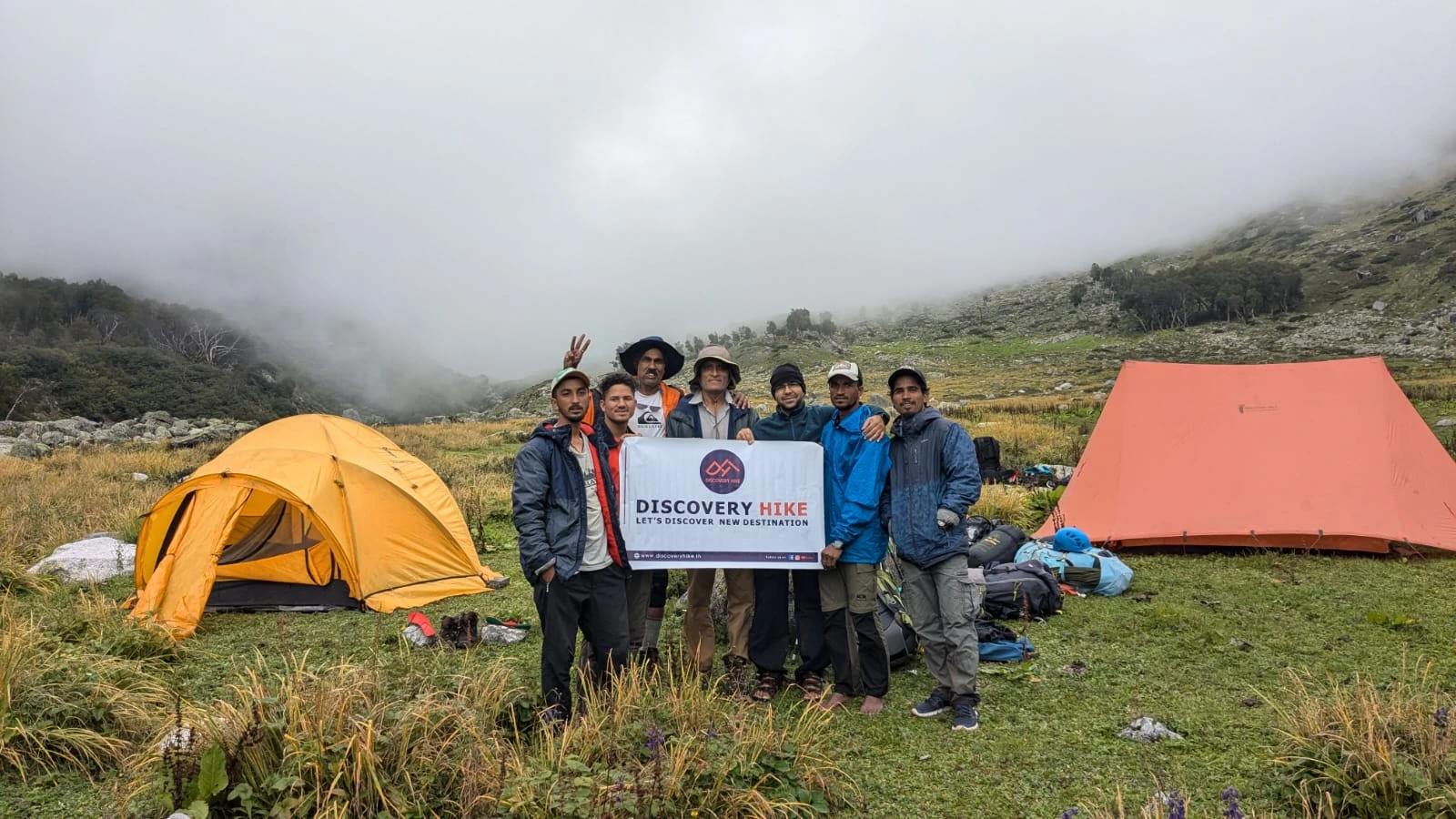
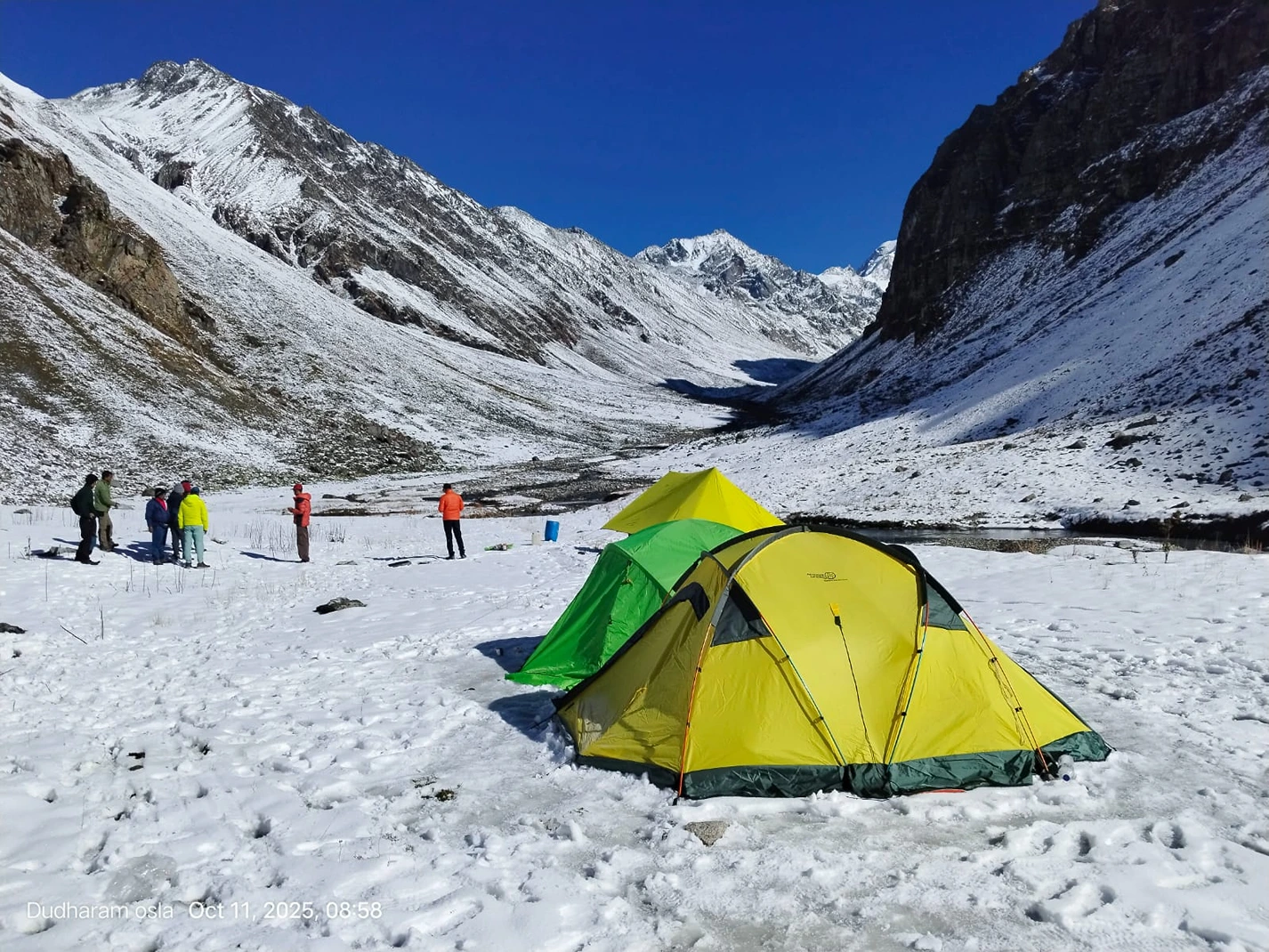
Our Gallery
₹ 24,000
₹ 18,000 28% off
Per Person
Key Highlights
- ➧ Duration : 9D/8N
- ➧ Elevation : 4,200 m
- ➧ Best Time : Oct - March
- ➧ Pick Up & Drop : Dehradun
Upcoming Batches
For Any Queries
+91-9458118063 | +91-7579480944
Read
Client's Feedback
Verified Phullera Ridge Trek. It was a great experience to trek over phullera ridge with discovery hike. The ridge trek was very very challenging as well as full of excitement. Enjoy those days with nice guide, foods and other facilities that provided by the discovery hike.Posted onVerified Outstanding Behaviour of Ganga, Prakash & the team were very heart warming.. They provide us outstanding foods and accommodation.Posted onVerified Bali Pass ( Discovery Hikes ) If you like to get drenched in nature then this is it ! Bali Pass is full of unexplored jungles, flower valleys, waterfalls, glaciers and wild berries to eat 🤤 All this experience gets even more amazing when you have an experienced crew by your side ! Discovery hikes provide you with an unforgettable experience coz they provide you with great food (tasty) & sweet dish at an altitude you cant expect. Moreover, the survival tips and they take care of your tantrums like a mother 😅 Ganga Rana, Mayank bhaiji & team made our experience more comfortable and we did the summit with moderate ease. Safety wise, it's a heads up with this team. P.S. - If you that guy who lags behind everytime and gets exhausted very easily 😂, Don't worry ! Discovery hikes won't leave you alone ! There is a guide each in the front, middle & back of the group.Posted onVerified Super duper adventurous trip ever Myself Kirti from Delhi...this is my 2nd trek with discovery hike team..Bali pass is a high altitude and long trek which needs everything like medication food shelter washrooms and mental support and motivation....and I must tell Ganga & Govind Rana team provides us everything whatever say variety of food like jalebi, gulab jamun, shahi toast, soup, noodles, pakoda, rajma rice,,there is no ending of food varieties for all days which we never expect from anyone in 16200ft,,,both guys and his team like porters all are very very supportive in all stages,,always they ready to giving his hands to someone's hands for support (jinka ❤️ sensitive h like me),,,,, they never say NO,,,,, I was in need of extra support for trekking and these guys gave me full support from starting to end.....in every step I scared from walking but Govind & Ganga were saying to me "DARNA NAHi JAb MEI HU...kahe darna..mei kheti ok sir😝😝😝....their tents/sleeping bags was good....there was lots of activities between the way like rappling, river crossing,, hiking,, ect....if u like adventure then u should go with this team.... discovery hike team is very hardworking by nature....thankss to alllll Ganga & Govind discovery hike team for Marvelous Adventure I had ever in my life.............we will come back again......seeeuuuuuSooonnn.....Posted onVerified Best treking company in Himalayas One of the finest treking company in Himalayas of India. They serve you the best food more the 4 times a days. Sweets in dinner and very friendly people always ready to solve the problem we face on the trek. Very humble and professional people. Love to trek with ganga and his team. Thank you for the wonderful 👏 experience.Posted onVerified Discovery hike Amazing experience with discovery hike spacial thanks to mr. Ganga rana for providing such a great service with exoerienced guide....i did 3 treks with the company.. Harkidun kedarkantha and balipass... I had a good time on the trail... Five star.. 🖤Posted onVerified Bali pass trek I trek with Discovery Hike on Bali Pass from 3-11 September 2021. I had experienced many treks with different adventure companies but Ganga bhaiya and his team is one of the best in all fronts, he and his very best team take care of us. One of the things that needs to complete a difficult trek is food they provide you excellent food, at such a high altitude their food quality doesn't depreciate. Thanks to Ganga bhaiya, Mayank bhaiya and Govind bhaiya and all the staff of Discovery Hike we made it till end. The very last day is like leaving a family. All the best for future expeditions.Posted onVerified Most recommendable Team....worth time and Money This was the best trip we ever had... although with Ganga as guide trip becomes more and more interesting every time , his motivational and thrilling Stories keep us goin on and on plus food is sth beyond compare as it is very difficult to have good food on very high altitude but they made it..his team is the best, very supportive and friendly. They helped us every time we were exhausted and kept us safe till the last destination which was recommendable job. Looking forward to next trip 🤟🏻🥳Posted onVerified Trek with Discovery Hike is like full paisa vasool. This is my 3rd trek with discovery Hike. Trek with discovery Hike is awesome and memorable. I started my trekking journey from Delhi with my friends and they pick us from Dehradun to Sankri Village by comfortable taxi and provide us very delicious and tasty food. Provide A very helpful, experienced guide. At the high altitude, they provide us very warm nd hygiene tents and sleeping bags. and no one can match their taste in food. Thank uh so much Ganga Rana, Govind bro and all team of Discovery hike for providing us all facilities, delicious food, good memories and lot of fine experience. I'll do more treks with ur team.Posted onVerified Best winter trek with the best people Had an amazing experience with Discovery Hikes. Thanks to Randev Ji Urf Hodda Ji for being an amazing trek guide. 😊Posted on
Checkout
Other Trek